

Pizza ovens run 700°F to 950°F at the dome — hot enough to blister skin through a standard oven mitt in under two seconds — and that heat gap is exactly why generic kitchen gloves fail at the peel. This guide breaks down what bbq gloves for pizza oven work actually need to hold up, which materials handle direct flame versus radiant heat, and where lightweight disposable gloves fit next to heavier leather or aramid options.
- BBQ gloves for pizza oven work need heat resistance well above the 400-500°F ceiling of standard oven mitts.
- Aramid and Kevlar-style gloves handle direct flame and hot stones; disposable BBQ gloves with heat-protection liners suit quick handling of hot trays and plates.
- Wrist and forearm coverage matters more at a pizza oven's mouth than at a standard backyard grill.
- Disposable gloves win on hygiene and fast swaps between pizzas; reusable leather or aramid gloves win on ember and stone handling.
Why this matters
Pizza oven cooks handle food and tools inside a heat band most kitchen gear was never built for. A backyard gas grill sits food over a heat source below it; a wood-fired or gas-fired pizza oven surrounds the cook's hand with radiant heat from the dome, the deck, and the open flame at once. That's a fundamentally different exposure than lifting a rack off a smoker.
Standard silicone oven mitts are commonly rated to roughly 400-500°F. Neapolitan-style pizza ovens routinely run 800-900°F at the dome in 2026, and even home countertop models push past 700°F. A glove that's fine for pulling a roasting pan out of a conventional oven can start to degrade the moment it brushes the deck of a hot pizza oven, which is why BBQ gloves and pizza oven gloves aren't interchangeable searches — they're solving different problems.
The disposable BBQ gloves with heat protection liners from PepperMate address the handling side of that gap: touching hot trays, plates, and finished pizzas without transferring grease or getting burned on contact. They are not a substitute for a heavy aramid glove used to reposition a baking stone by hand, and this guide draws that line clearly.
What pizza oven cooks need from a glove
A pizza oven glove has to do three things a standard grill glove doesn't: survive radiant heat from above and the side, keep dexterity for turning a peel, and cover past the wrist where the oven mouth sits closest to bare skin. Buy for that job, not for the label that says BBQ.
Check your oven's actual dome temperature before buying gloves
Most buying mistakes start here — people shop for heat-resistant gloves without knowing whether they're working a 450°F gas grill or a 900°F wood-fired dome.
- Check the manufacturer spec sheet for your oven's stated dome temperature range.
- Note whether you're reaching near the flame (wood-fired, gas with visible flame) or only near a hot deck (electric countertop ovens).
- Separate handling-hot-food tasks from handling-the-fire tasks — they call for different gloves.
- If you don't know your oven's ceiling temperature, assume 900°F for any wood-fired unit and shop accordingly.
Match glove material to the heat zone you're handling
Once you know your heat range, the material choice narrows fast.
- Silicone-lined mitts: fine for pulling a finished pizza off the peel or handling a hot serving pan, weak near open flame.
- Leather: tolerates brief direct flame and ember contact, stiffens with repeated high heat, offers less dexterity.
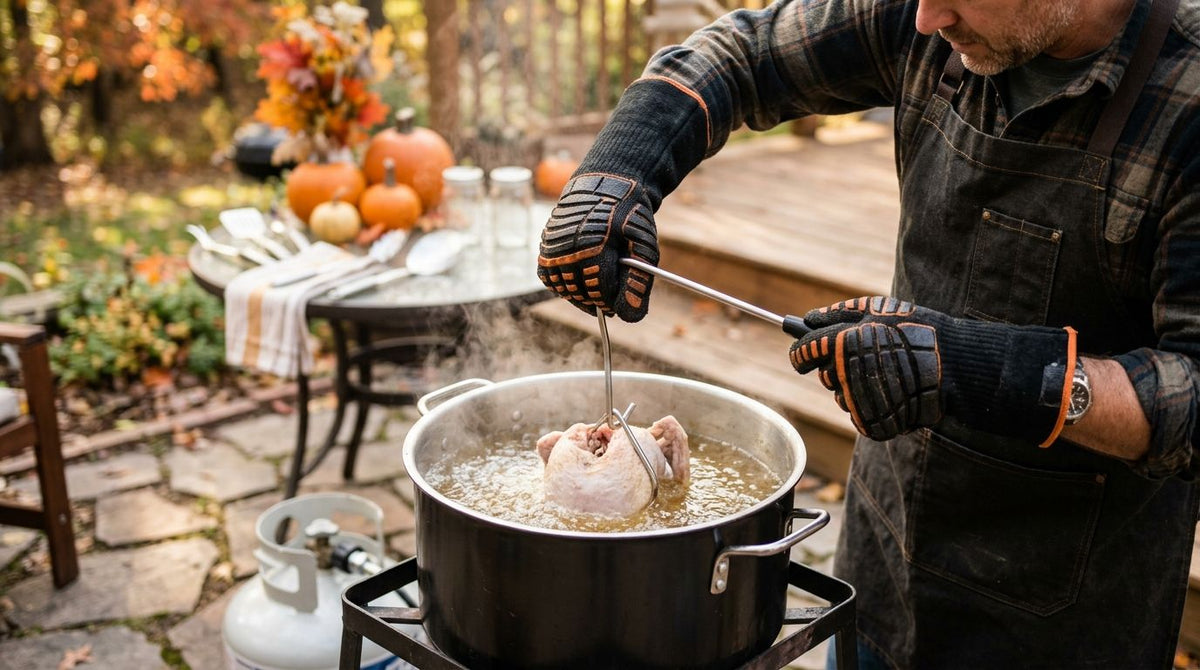
- Aramid/Kevlar blends: the standard material across most published heat-resistant BBQ glove lines, commonly rated to withstand contact well above 900°F for short exposure.
- Disposable nitrile-style gloves with heat liners: built for quick, repeated handling of hot food and surfaces rather than embers or open flame — this is where PepperMate's disposable BBQ gloves sit.
Protect wrists and forearms, not just palms
A pizza oven's opening puts your forearm closer to radiant heat than a standard grill lid ever does.
- Look for a gauntlet cuff that extends at least 4-6 inches past the wrist.
- Avoid gloves with exposed elastic or fabric seams near the cuff — they're the first part to scorch.
- If you're using a short-cuff disposable glove, layer a separate forearm sleeve for deep-oven reaches.
- Test the cuff length against your specific oven door height before committing to a pair.
Choose grip texture for oven tools, not just heat resistance
A glove that resists heat but slips on a metal peel handle still gets you burned.
- Silicone-dot or textured palm grips hold wooden and metal peel handles better than smooth leather.
- Wet hands from dough prep reduce grip on any material — dry hands before grabbing hot tools.
- Test grip on your actual peel handle, not just in the store or on the box.
- Avoid gloves marketed purely for smoking or slow-cooking — they're built for stationary grip, not tool handling.
Decide between reusable and disposable gloves
This is a workflow decision as much as a heat decision.
- Reusable aramid or leather gloves make sense if you're running the oven for hours and handling the fire directly.
- Disposable gloves make sense for quick, repeated food-handling tasks between pizzas — pulling a finished pie, moving a hot plate, checking a topping.
- Disposable gloves also solve the grease-and-mess problem that reusable leather gloves don't — you're not scrubbing a pair of leather gloves after every bake.
- If you're serving guests between bakes, disposable gloves let you swap a torn or greasy pair mid-service without stopping to wash anything.
Test fit and dexterity before the pizza goes in
A glove that fits wrong fails exactly when you need it most — mid-turn, with a hot peel in hand.
- Try picking up a peel handle and rotating it a quarter turn before the oven is even lit.
- Check that fingers reach the end of each glove finger — loose tips reduce control.
- Confirm the glove doesn't bunch at the palm when you grip.
- Test one full pizza cycle — load, turn, pull — before trusting the glove for a real service.
Store and inspect gloves between sessions
Heat-damaged gloves fail quietly, not dramatically.
- Check aramid and leather gloves for cracking, thinning, or scorch marks after each use.
- Retire any reusable glove with visible thinning at the palm or fingertips — that's where heat exposure concentrates.
- Keep disposable gloves in a sealed box away from the oven's ambient heat so the liner doesn't degrade before use.
- Replace disposable gloves per pizza or per serving round rather than reusing a torn pair.


Comparison: glove options for pizza oven cooks
| Option | Best for | Heat handling | Verdict |
|---|---|---|---|
| Silicone oven mitts | Pulling finished food, short handling tasks | Rated roughly to 400-500°F in most published specs | Skip for oven-mouth or flame work |
| Leather BBQ gloves | Wood-fired ovens, ember and log handling | Tolerates brief direct flame contact | Hold — good for fire tending, weak on dexterity |
| Aramid/Kevlar BBQ gloves | High-heat dome work, moving hot stones | Commonly rated above 900°F for short exposure | Buy for direct-flame and ember tasks |
| PepperMate disposable BBQ gloves with heat protection liners | Quick handling of hot food, plates, and trays | Built for repeated hot-surface contact, not open flame | Buy for food handling between bakes |
“If the glove can't survive picking up a hot pizza stone and holding it for a few seconds, it's rated for a grill, not an oven.”
Common mistakes pizza oven cooks make
- Using a standard oven mitt at the oven mouth. It's rated for a kitchen oven interior, not radiant heat from an open flame three inches away.
- Grabbing a metal peel handle bare-wrist. The handle conducts heat back toward the hand faster than most cooks expect from a pizza setup.
- Buying a glove rated for smoking, not flame. Smoker gloves are built for sustained low-to-moderate heat, not the flash exposure of a wood-fired dome.
- Letting a reusable glove sit near the flame edge between uses. Repeated near-flame exposure scorches material long before it visibly fails.
- Skipping the dexterity test. A glove that protects your hand but won't let you turn a peel gets tossed aside mid-bake — and that's when burns happen.
FAQ
What temperature do BBQ gloves for pizza ovens need to handle?
Pizza oven gloves should handle at least 500°F for food-handling tasks, and 900°F or higher for anything near the dome flame or hot stones. Standard oven mitts, rated closer to 400-500°F, fall short of most wood-fired setups in 2026.
Are regular BBQ gloves safe for a pizza oven?
Grill-rated gloves built for gas or charcoal grilling are often fine for handling food near a pizza oven's opening, but not for touching the deck or flame directly. Check the glove's stated heat rating against your oven's dome temperature before assuming it transfers over.
Is leather or aramid better for pizza oven gloves?
Aramid and Kevlar-style gloves generally offer better heat resistance and dexterity for turning a peel, while leather holds up well to direct ember contact but stiffens faster with repeated high heat. Pick aramid for dome and flame work, leather if you're tending logs or coals.
Can disposable gloves handle pizza oven heat?
Disposable BBQ gloves with heat protection liners are built for handling hot food, plates, and trays, not for touching open flame or hot stones directly. Use them for the food-handling side of pizza oven work and pair them with a heavier glove for fire tasks.
How do I know if my BBQ gloves are too worn to use safely?
Check for thinning, cracking, or scorch marks at the palm and fingertips after every session, since that's where heat exposure concentrates fastest. Retire reusable gloves at the first sign of thinning rather than waiting for visible failure.
Do pizza oven gloves need to cover the wrist?
Yes. A pizza oven's mouth puts the forearm closer to radiant heat than a standard grill lid, so a gauntlet cuff of at least 4-6 inches is worth prioritizing. Short-cuff gloves work fine for plate handling but not for deep-oven reaches.
What's the difference between grill gloves and pizza oven gloves?
Grill gloves are typically built for heat coming from below the food, while pizza oven gloves handle radiant heat from the dome, deck, and open flame at once. Material and cuff-length requirements end up higher for pizza oven work.
One last thing
Most pizza oven cooks own exactly one pair of gloves and use them for everything from stacking wood to plating the finished pie — that's the setup that causes burns. Keep a dedicated pair of disposable gloves for food handling between bakes, and reserve a separate aramid or leather pair for anything that touches the flame or the deck directly. Two glove types cost less time and skin than one pair doing both jobs badly in 2026.