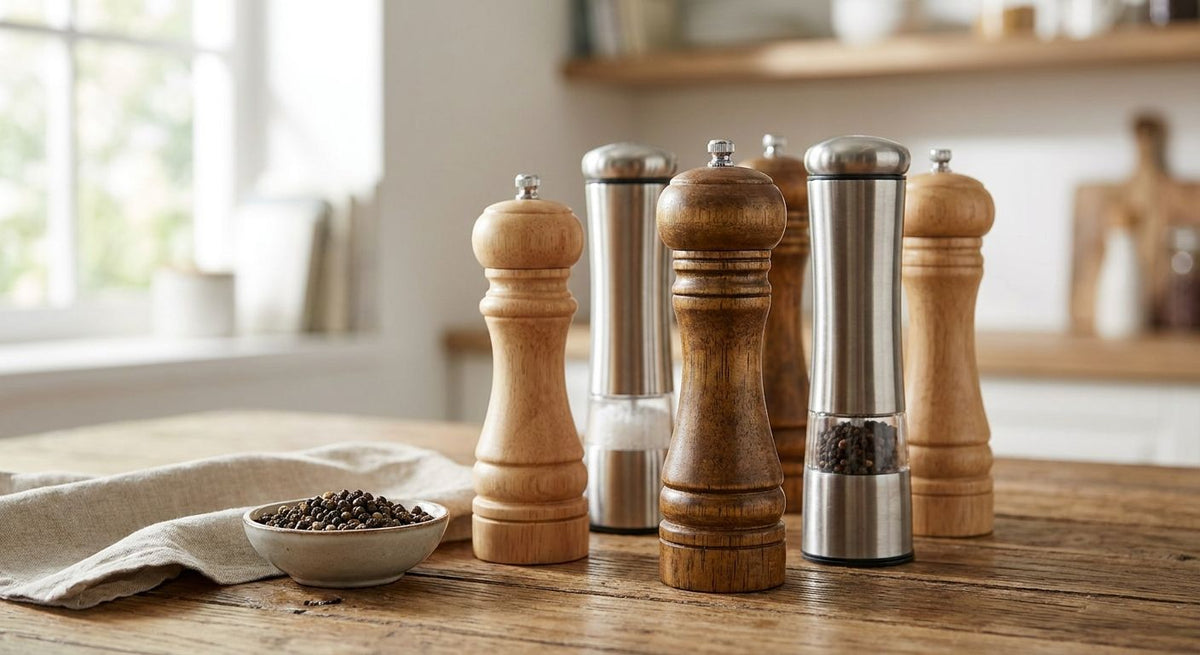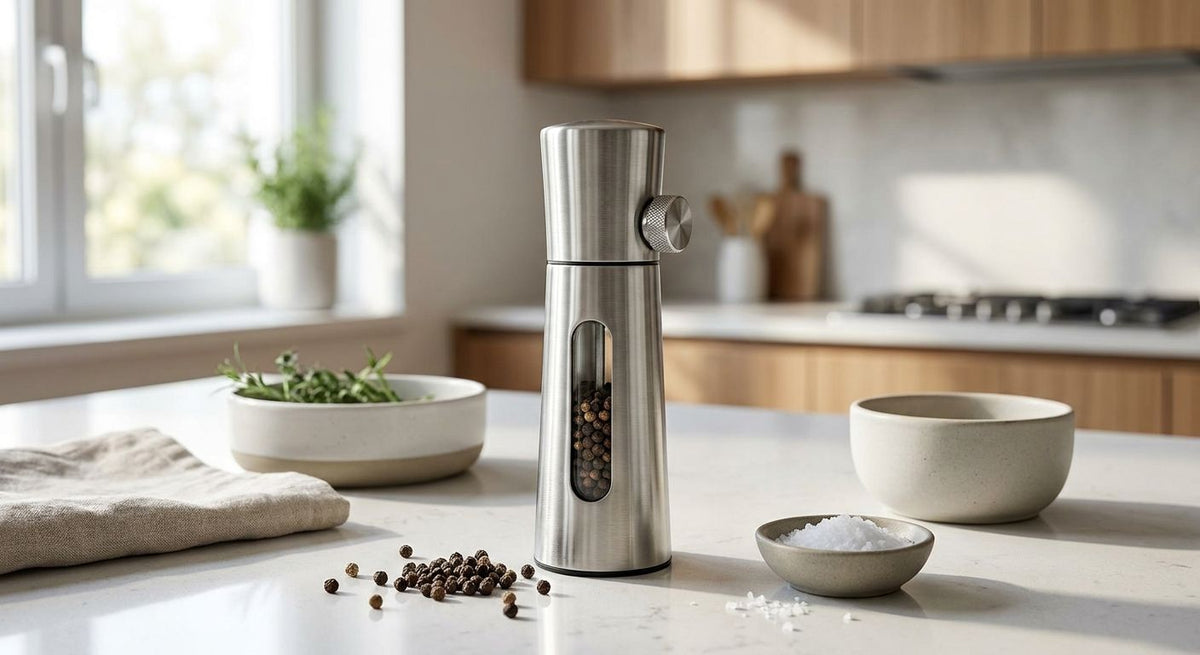


Pink Himalayan salt looks stunning in a glass or wood mill, but not every mill handles those chunky, mineral-streaked crystals the same way — some clog, some crush unevenly, and some just aren't built for rock salt at all. This guide covers who should be grinding pink Himalayan salt at home in 2026, what to check before you load a mill with it, and which coarse salts actually perform better if the pink stuff keeps jamming your grinder.
- Pink himalayan salt for salt mill use works best with an adjustable ceramic mechanism set to a coarse grind, not a fine one.
- The Peppermate Traditional Salt and Pepper Mill Bundle handles large Himalayan chunks without jamming — Buy for daily cooks in 2026.
- Himalayan rock salt runs low in moisture, so it flows better than damp sea salt in humid kitchens.
- Skip pre-ground 'shaker' pink Himalayan salt in a mill — it's already too fine to grind further and just sits in the hopper.
Why this matters
Pink Himalayan salt is mined rock salt, not evaporated sea salt, and that changes how it behaves inside a grinder. It's harder, drier, and less uniform in grain size than table salt or even most sea salts, so a mill built for fine table salt will choke on it while a mill built for pepper (which is used to irregular, oily peppercorns) often handles it fine. Get the salt-to-mill match wrong in 2026 and you'll spend more time unjamming the mechanism than seasoning dinner.
Who this is for
This guide is for home cooks who already own or are shopping for a salt mill and want the texture and mineral color of pink Himalayan salt at the table, not the fine pre-ground shaker version. If you cook daily and want a coarse, fresh-ground finishing salt for steaks, roasted vegetables, or salads, the mill-and-salt pairing matters more than the marketing on the bag.
What to look for in pink Himalayan salt for a salt mill
Grain size consistency
Himalayan rock salt is cut from mineral deposits, so bag-to-bag grain size varies more than manufactured sea salt. Look for salt labeled "coarse" or "grinding grade" specifically — fine or medium grinds sold for shakers will jam a mill's dial mechanism because there's nothing left to crush.
Mechanism material
Salt is corrosive to most metals over time, which is why dedicated salt mills use ceramic grinding mechanisms instead of the carbon-steel gears some pepper mills use. A ceramic mechanism resists pitting and keeps grinding smoothly through 2026 and well beyond, where a metal one will rust or seize.
Adjustable coarseness
A fixed-grind mill gives you one texture only. An adjustable dial lets you go from a fine table grind for cooking to a coarse crunch for finishing a steak, which matters more with Himalayan salt because its irregular crystal shape produces more texture variation than sea salt at the same dial setting.
Moisture and clumping resistance
Himalayan rock salt runs drier than sea salt, generally under 1% moisture, so it resists clumping in humid kitchens better than damp Celtic or fleur de sel styles. If your kitchen runs warm or you live somewhere humid, this dryness is the biggest practical advantage pink Himalayan salt has over wetter alternatives — check the guide on how to pick the right salt for grinding for more on moisture and mill compatibility.
Cleaning and hopper capacity
Larger Himalayan chunks need a hopper wide enough to load without hand-crushing pieces first. A narrow-neck mill built for fine table salt will make you break every crystal down before it fits, which defeats the point of buying coarse salt in the first place.
Cost per use
Coarse pink Himalayan salt costs more per ounce than table salt, and a mill wastes some product in the mechanism over time. Factor that into how often you'll actually reach for it versus a everyday coarse blend.
Top picks
The safe pick — Peppermate Traditional Salt and Pepper Mill Bundle. This pairs a dedicated salt mill with a pepper mill, both using PepperMate's ceramic mechanism, and the wide hopper accepts coarse Himalayan chunks without pre-crushing. One dial adjustment takes it from fine to coarse in a quarter turn. Verdict: Buy if you're setting up a mill from scratch for 2026.
The wildcard — Coarse Salt, Pepper & Garlic Blend. Not pure Himalayan salt, but a pre-blended coarse mix built for grinding, which solves the jamming problem entirely because the grain size is engineered for mills rather than mined. Good for cooks who want flavor complexity without managing two separate mills. Verdict: Consider as a daily driver alongside pink Himalayan salt for special occasions.
The backup plan — premium coarse sea salts. If pink Himalayan salt keeps clumping in a humid kitchen, a drier premium sea salt is worth comparing; the best premium sea salt for your salt mill breakdown covers grain hardness and flow rate side by side. Verdict: Consider if you cook in a humid climate.
The one to skip — pre-ground pink Himalayan "table" salt. It's already fine-milled at the factory, so loading it into a grinder does nothing except add wear to the mechanism. Verdict: Skip — buy the coarse grinding-grade bag instead.


What to avoid
- Fine or "table grind" pink Himalayan salt in a mill — there's nothing left for the mechanism to crush, and you'll wear the ceramic burrs for zero benefit.
- Metal-mechanism mills marketed for pepper only — salt is corrosive over years of use, and a mill without a ceramic or salt-rated mechanism will pit or seize faster than the manufacturer's warranty period suggests.
- Damp, clumpy Himalayan salt stored in a humid pantry — it'll jam even a good mill regardless of grain size, so store it airtight, not just the mill itself.
Verdict comparison
| Salt type | Grain size | Best mill setting | Verdict |
|---|---|---|---|
| Pink Himalayan, coarse grinding grade | 2-4mm | Coarse, open dial | Buy for finishing |
| Coarse Salt, Pepper & Garlic Blend | Pre-mixed coarse | Mid setting | Buy for everyday |
| Coarse Celtic Grey Sea Salt | Coarse, higher moisture | Coarse, clean often | Consider |
| Pink Himalayan, fine/table grade | Pre-ground fine | N/A, don't mill | Skip |
FAQ
Can you put pink Himalayan salt in any salt mill?
Not every mill handles it well — coarse Himalayan chunks need a wide hopper and a ceramic mechanism rated for rock salt, not a mill built for fine table salt. Adjustable ceramic mills like the Peppermate Traditional Salt and Pepper Mill Bundle handle it without jamming.
Is pink Himalayan salt better than sea salt for grinding?
Pink Himalayan salt runs drier, generally under 1% moisture, so it resists clumping better than wetter sea salts like Celtic grey in humid kitchens. Sea salt often has a brinier, more complex flavor, so the choice comes down to climate and taste, not one salt being objectively superior.
Why does my Himalayan salt mill keep clogging?
Clogging usually means the grain size is too fine for the mechanism, the salt has absorbed moisture and clumped, or the mill's ceramic burrs aren't set wide enough. Switch to coarse grinding-grade salt and store it airtight to fix most jams.
What mill mechanism is best for pink Himalayan salt?
Ceramic mechanisms are the standard for salt mills in 2026 because salt corrodes metal gears over repeated use. An adjustable ceramic dial also lets you switch between a fine cooking grind and a coarse finishing texture.
How much does pink Himalayan salt for a mill cost?
Coarse grinding-grade pink Himalayan salt typically costs more per ounce than plain table salt because of the mining and sorting required to keep grain size consistent. Check current pricing on the product page before buying in bulk.
Can you use the same mill for pink Himalayan salt and black pepper?
No — salt and pepper mechanisms are built differently, and running salt through a pepper mill accelerates corrosion on metal gears. Use a dedicated salt mill or a bundle set with separate mechanisms for each.
Does pink Himalayan salt need to be stored differently once it's in a mill?
Keep the mill's hopper closed and store it away from stovetop steam, since Himalayan salt's low moisture content is also what makes it prone to absorbing ambient humidity quickly. A tight lid preserves the coarse texture longer.
Is coarse pink Himalayan salt the same as table salt with pink coloring?
No — the pink color comes from trace minerals like iron oxide picked up during mining, and coarse grinding-grade salt is cut and sorted specifically for mills, unlike fine table salt which is milled at the factory.
One last thing
Himalayan rock salt varies in color and mineral density depending on which layer of the deposit it's cut from, so two bags labeled identically can grind at slightly different rates in the same mill. If your mill grinds one bag smoothly and jams on the next, it's usually the salt batch, not the mechanism.